
Start a Clinch County Property Records Search
Start with the clue you already have. The Clinch QPublic search is the first stop. It works with a street address, parcel identifier, or assessor-listed owner in Clinch County. A parcel card there can tie the location to a legal description, acreage, values, and sale references. It also links to a map. Labels and update dates on the portal change over time. Confirm them during your search.
For a party name, deed citation, lien, easement, security deed, or plat, the statewide GSCCCA Real Estate Index is the right tool. Tax payments go to the Tax Commissioner. Assessment values and appeals belong to the Board of Tax Assessors. Remember that a map line is a reference layer, not a survey. An assessment entry is not proof of title in Clinch County property records.
- Normalize the street and ZIP with the official USPS lookup if the address is uncertain.
- Search QPublic by the best available address, owner name, or parcel key and save the exact parcel citation.
- Use the GSCCCA name index or book-and-page form to identify the recorded transfer and later filings.
- Check the Tax Commissioner source for the bill and use the GIS view for parcel context.
- Request a copy from the responsible clerk or office when an image, old volume, or current detail is not online.
The Offices Behind Clinch County Property Records
Three offices at Court Square split the core work. The Clerk of Superior Court records deeds, security instruments, easements, plats, and liens. The Board of Tax Assessors keeps the tax digest and values property. It reviews returns and hears appeals. It also maintains the maps used for appraisal. The Tax Commissioner prepares and collects the tax bill. It processes the digest, handles exemptions and delinquencies, and manages mobile-home tax functions. Knowing the split saves time. Ask the wrong suite and you may find yourself requesting a value change from the tax collector. You might instead request a deed copy from the assessor.
Clinch County Clerk of Superior Court
25 Court Square, Suite C
Homerville, GA 31634
(912) 487-5854
Clinch County Board of Tax Assessors
25 Court Square, Suite D
Homerville, GA 31634
(912) 487-2561
Clinch County Tax Commissioner
25 Court Square, Suite H
Homerville, GA 31634
(912) 487-2480
Read Clinch County Property Records on QPublic First
The county-linked Clinch QPublic landing page does more than launch a parcel search. It explains how the assessor's role differs from the Tax Commissioner's. It also gives the assessment office contact and posts current notices. That distinction matters. The assessor sets the value. The Tax Commissioner calculates and collects the bill from the approved digest. The page also posts weekday public hours, a midday closure, and dated 2026 assessment information. Check it before any visit or deadline.
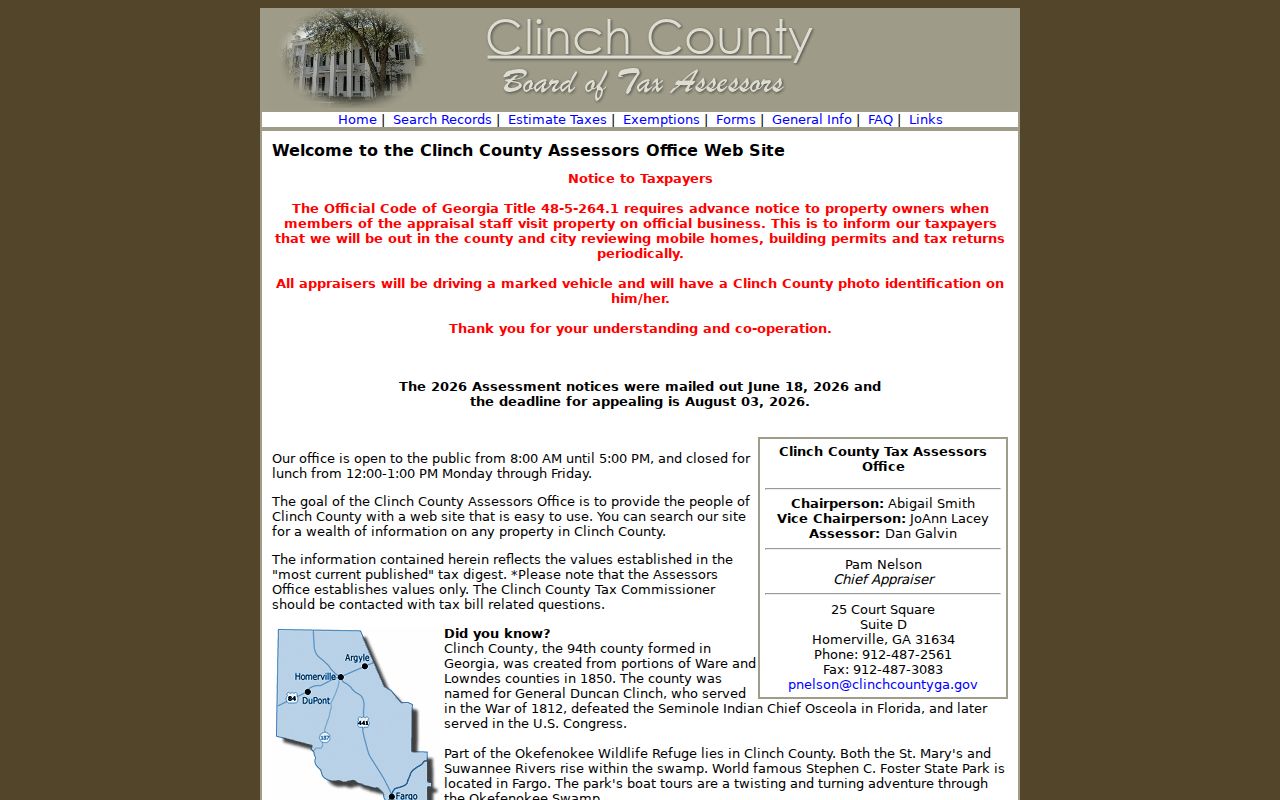
Hours, staffing, notice dates, and deadlines shift over time, so rely on the live page rather than any saved image.
Use GSCCCA in a Clinch County Property Records Search
The GSCCCA Real Estate name search takes a party name, party role, instrument type, county, and date range. It can sweep neighboring counties too. A result typically shows the indexed spelling of a name and whether that party was grantor or grantee. It also lists the instrument type, the recording date, and the book and page citation. The Clinch index itself reaches back to January 1, 1990. Its good-through date moves as filings are added. Recheck the range each time you search deed records there.
| Search control | Best use | What to copy |
|---|---|---|
| Grantor, grantee, or all parties | Separate sellers from buyers | Exact indexed name and role |
| Instrument type | Focus on deeds, liens, plats, or security instruments | Instrument label |
| County and dates | Keep the search within Clinch and a likely period | Recording date and index cutoff |
| Book and page | Retrieve a known citation | Book, page, and image status |
Clinch does not appear in the separate GSCCCA property or subdivision search. Use the name index and the book and page form instead. If an image or an older citation is missing, ask the clerk.
Add FANS Alerts to Clinch County Property Records Work
The statewide Filing Activity Notification System is known as FANS. It lets a registrant watch a name, a property address, or a document with its book and page. Alert categories cover deeds, liens, plats, UCC filings, and PT-61 activity. It earns its keep after a purchase, during estate work, or whenever you are waiting on a later filing tied to a known parcel. FANS reports indexed activity only. It will not block a filing. It will not prove fraud. It will not replace periodic review of Clinch County property records. Names vary in the index, so an entity's legal name and its common variants may each need their own alert. In practice, that may mean separate alerts.
Which Clinch County Property Record Answers the Question?
No single record tells the whole story. A deed records a conveyance, and an assessor card supports taxation. A tax account tracks the bill. A parcel layer helps locate mapped land. When those systems fall short, court, probate, lien, and historical sources may fill the gap. Pick the source that fits the question. Then keep the parcel number, the indexed party spelling, the date range, and the book and page citation. That way each finding can be joined to the next.
| Record Type | What It Documents | Kept By | Access |
|---|---|---|---|
| Deeds and security instruments | Transfers, parties, recording references, secured interests | Clerk of Superior Court | GSCCCA index; clerk for copies |
| Liens and court filings | Recorded claims and disputes of record | Clerk of Superior Court | GSCCCA and Georgia Courts eAccess |
| Assessment and tax | Fair-market and assessed values, exemptions, bills | Assessors and Tax Commissioner | QPublic and GovernmentWindow |
| Plats and parcels | Lot descriptions, map context, acreage | Clerk and assessment mapping | Recorded plats and Schneider GIS |
| Municipal land-use files | Zoning, permits, inspections, planning actions | Homerville, Fargo, or Argyle | City Hall or written request |
A question about a transfer belongs in the Clinch County deed records, while a value or bill question starts with the assessor and the tax roll. A city permit cannot establish the owner of record, and a parcel layer will not settle a boundary dispute. Used together, these records explain a property without granting any one of them more authority than it carries.
What a Clinch County Property Records Card May Contain
A live QPublic card can carry a lot. It lists the parcel or map identifier, the assessor-listed owner, mailing and situs addresses, legal description, acreage, property class, district, land value, improvement value, total fair-market value, assessed value, exemptions, and sales references. Building details, a sketch, a printable card, or a map link may appear as well. Exact labels and the refresh date vary, so verify them against the live record. The card is an assessment tool. For the transfer itself, go to the deed.
Four terms that should not be merged
Parcel ID: the assessment system's key for each tract. Situs: the physical location of the property. Mailing address: where assessment mail is sent. Legal description: the land description carried in the deed or plat.
Read the card carefully. A mailing address outside Clinch County proves nothing about where the parcel lies. Owners often list distant addresses for tax mail. A sale reference on the card works the same way: it points to a recorded deed. It replaces nothing. Pull the instrument itself and read it before drawing conclusions about the conveyance.
How Assessment Math Shapes Clinch County Property Records
Georgia law assesses property at 40 percent of fair-market value. The annual assessment notice states the value and lays out the appeal route. State guidance allows 45 days from the notice date. That appeal goes to the county board of tax assessors. When the tax bill arrives, millage rates apply to the taxable assessment after qualifying exemptions. Market value, assessed value, taxable value, and the amount due are related but never interchangeable.
The Clinch QPublic notice reported 2026 assessment notices mailed June 18, 2026. The appeal deadline was August 3, 2026. Those dates belong to that cycle alone. Do not reuse them for another year. Go by the date printed on the notice you actually receive. Confirm the current deadline with the Board of Tax Assessors. Keep proof of filing. Homestead and other exemptions follow their own eligibility and filing rules.
Older Clinch County Property Records Leave the Web
Online indexes are only the newest layer of Clinch County record keeping. Older material lives elsewhere. The Georgia Archives offers research help. Its holdings include deeds, estate records, tax material, court minutes, and county microfilm. FamilySearch catalogs Clinch Court of Ordinary minutes from 1867 through 1931. It also covers Inferior Court records from 1868 through 1901, and miscellaneous estate material from 1919 through 1921, across five microfilm reels. Access may require an account. A visit to a FamilySearch Center is another route, or you can browse images without a name index.
These sources matter when land passed through an estate, a guardian, or a court order. They also matter when an older deed citation never surfaces in the modern index. Note the volume, page or image, court date, decedent or petitioner, heirs, and the exact property wording. Record any later sale reference too. Then return to the clerk's books or deed index. That step connects the historical event with a later recorded conveyance in Clinch County.
City Records Add Land-Use Context
Homerville, Fargo, Argyle, and Du Pont are incorporated places inside Clinch County. Their municipal files are no substitute for county deed records. Homerville points requests for its zoning ordinance, zoning map, and zoning meeting minutes to City Hall. Argyle offers a written public-information request route. It shares details on permits, inspections, certificates of occupancy, and fire prevention. Fargo's current municipal schedule and any live permit index take a direct call to confirm.
A city file helps you understand zoning, authorized work, a planning action, or an address clue. Then match the parcel through county assessment and recording sources. That step matters most where a postal city name, a city limit, and the legal parcel geography refuse to line up. A casual address search suggests they should.
Liens, Foreclosures, and Court Clues in Clinch County
The Clerk of Superior Court records liens, security deeds, plats, and other real-estate instruments in Clinch County. Civil cases may surface through the court route instead. Foreclosure, quiet title, and land disputes all travel this path. Georgia Courts eAccess lists Clinch Superior Court among its searchable jurisdictions. Coverage varies, though. Provider accounts, document availability, sealed material, and coverage windows all differ. Search the party name and date span. Note the court and case identifier. Then compare any real-estate citation against the GSCCCA deed index.
A missing result is not proof that no lien or case exists. Spelling differences can hide a match. Releases filed later can too. Limited image access and records outside the searched range can also conceal one. For purchase due diligence, estate work, or a dispute, certified records carry more weight. Qualified title help does too. Both beat a portal screen.
Requesting Clinch County Records Off Line
When a portal blocks access or lacks an older record, go to the counter, the telephone, the mail, or a written Georgia Open Records Act request. A focused request names the custodian, the record series, the parties or parcel, the date range, and a preferred electronic format, and says whether a cost estimate is needed before work begins. Georgia Attorney General guidance expects agencies to respond within three business days by producing records or explaining when they will be available and the legal basis for any withholding.
Fees can cover reasonable search, retrieval, redaction, and copying costs, and the first quarter hour of administrative work is free under that state guidance. Ask for native electronic files when the office can provide them. Broad questions invite delay. A request for a named deed book, assessment card, zoning map, or dated minutes gives the office a record it can actually identify.
Limits of Clinch County Property Records
Clinch County property records can show a great deal. They list the assessor's owner of record, the recorded grantee, the legal description, value, exemptions, tax status, and deed references. The mapped parcel appears too. What they cannot do is certify clear title, establish a surveyed boundary, or prove who occupies an address. They cannot supply a current market appraisal. A lien, plat, estate action, or city land-use file may surface as well. Georgia's Safe at Home program can substitute a designated address for eligible protected participants. Some records carry lawful redactions.
Lawful use. Use public records for land research, due diligence, estate work, and civic review. Never use owner information to stalk, harass, threaten, or harm a person.