
Clinch County Value Types
Georgia assessment records separate two figures. A fair-market estimate differs from the assessed amount used in tax math, while a transaction price comes from a sale record and may reflect terms unlike an open-market deal.
| Value | What It Is | Where |
|---|---|---|
| Fair-market value | Assessor's annual estimate | QPublic card / notice |
| Assessed value | Forty percent of fair-market value | Assessment card / notice |
| Last sale price | A dated transaction lead | Card / recorded deed |
| Land and improvements | Components of the total estimate | Assessment card |
These values can differ without an error. A sale may bundle several parcels, involve family terms, or be another non-arm's-length transfer, while the annual estimate uses its own valuation date. Exemptions change the taxable result, not the price.
Clinch QPublic Value Fields
The Clinch QPublic portal is the county's assessment route. A parcel card there lists land, improvement, total fair-market and assessed value, any exemption, assessment year, sale date and price, deed book/page, and property traits. Confirm exact labels and the update date on the live site. The Board of Tax Assessors at 25 Court Square, Suite D, Homerville handles valuation. It also handles returns, maps, inspections, notices, and appeals.
The image comes from the official Clinch QPublic landing page. It shows the entry point for the parcel search.
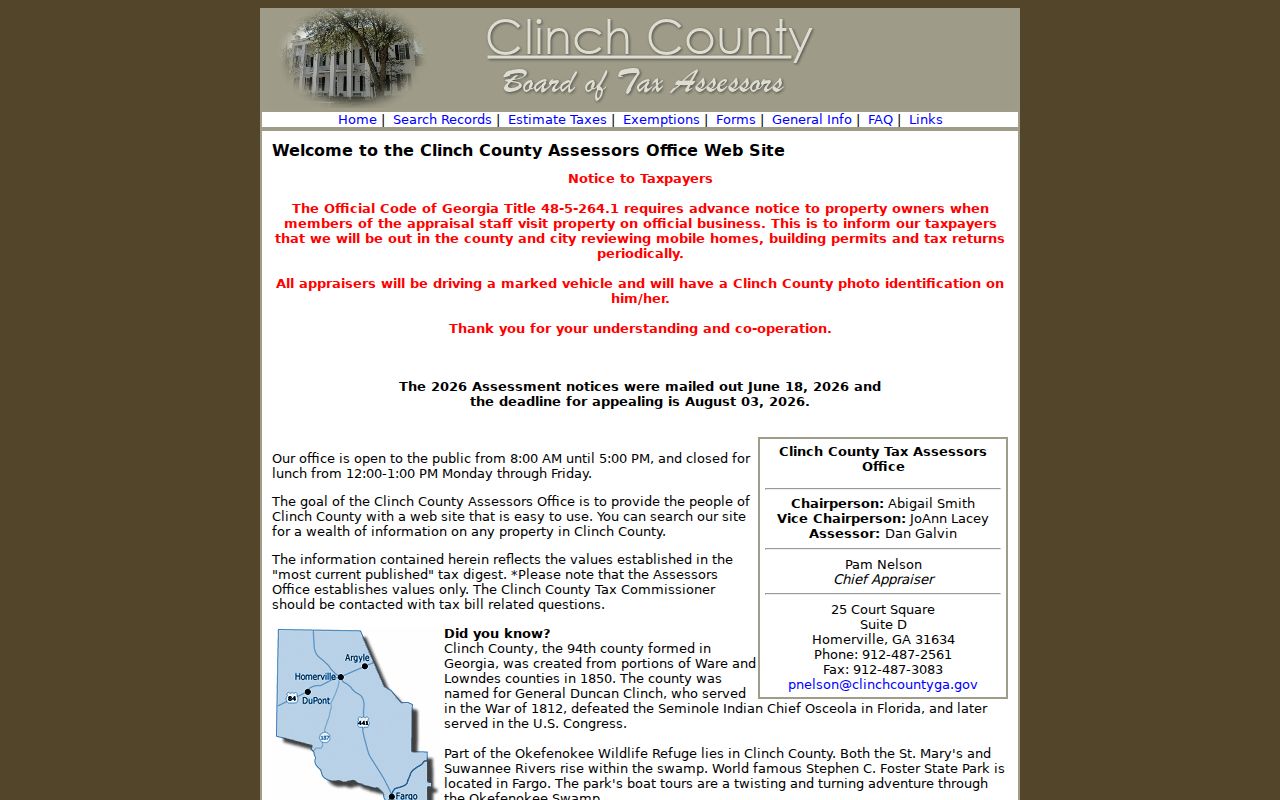
Use the live card for current value labels, dates, and notices.
Georgia's Clinch Assessment Ratio
The Georgia DOR FAQ explains the math. Assessed value equals 40 percent of fair-market value. Keep both labels separate. Never call the assessed number a sale price or expected proceeds, and keep the fair-market figure, assessed figure, assessment year, and exemption field distinct when analyzing value. Millage, exemptions, and district rules shape the bill after valuation.
Note: A value without its label and year is too vague to compare with a deed price.
Estimate Clinch County Record Value
Anchor every lookup to the parcel ID. An address alone can miss rural tracts or point to more than one candidate in Clinch County.
- Search QPublic by address, street prefix, owner, parcel ID, and legal information.
- Save land, improvement, fair-market, assessed, and exemption fields as labeled.
- Record the assessment year, card date, parcel ID, and property class.
- Compare a sale field with the dated deed and book/page citation.
- Assessed value
- The statutory assessment portion used in tax work.
- Fair-market value
- The assessor's estimate for the assessment date.
- Assessment ratio
- The percentage connecting fair-market and assessed value.
Clinch Sale Prices Need Deeds
A card's sale field is only a lead. The GSCCCA index supplies the rest. Use it to find the instrument, parties, date, and book/page, and ask the clerk for a copy when images require an account. A price may cover multiple parcels or a non-arm's-length transfer, so report the exact deed label and date rather than substituting an old sale for current market value.
Annual Clinch County Value Timing
Notices run on a different clock. The annual digest and deed recording each follow their own calendar. Save the assessment year and rely on the actual notice, since a recent deed does not mean the fair-market figure has changed. Ask the assessor about the card's update cycle.
Exemptions and Clinch Values
Georgia offers several exemption categories. Standard, senior, educational, floating, disabled-veteran, and surviving-spouse options all exist, and eligibility plus filing details require confirmation. An exemption lowers a tax calculation. It never changes a sale price, so read the exemption field and year without inferring age, disability, or family status from a lower taxable value.
Clinch Value Mismatch Controls
Capture exact labels for owner, fair-market value, assessed value, sale date and price, exemption, and year. Missing data needs a note. Write "not displayed" with the date. When a card, deed, and bill differ, keep each figure under its source and year rather than averaging unlike numbers into a new value.
Clinch County Value Evidence
A solid value file starts with the QPublic card. Keep the assessment year, lookup date, land and improvement components, fair-market value, assessed value, exemption field, and any sale reference together. A deed price needs its own paper trail. Add the parties, instrument, date, book/page, and the parcels conveyed. That keeps a transaction amount tied to the land and terms it covered.
Older comparisons call for care. Historical tax digests may show a person's annual land or tax entry, but they do not translate into modern dollars or prove a sale. Planning documents describe development goals and land-use concepts. They are not parcel appraisals or adopted zoning decisions. Every number should keep its original record type and date.
When the live portal hides a field, write "not displayed" and preserve the access date. Never estimate a missing assessed value from a sale, and never fill a sale price from a fair-market figure. The best comparison leaves unlike values separate.
Recent Clinch Value Leads
Treat news figures as leads. A March 2025 report about an old school-property sale cited a large amount. Proof requires Board of Education minutes, sale authorization, the recorded deed, and the parcel card. The same rule applies to any news figure.
Emergency relief works differently. Relief after a wildfire can extend filing or payment dates without changing ownership, assessment, or title, so preserve the notice and affected area apart from the parcel's value fields. That relief is not a new appraisal.
Clinch Land and Building Components
Clinch County parcel cards separate land value, improvement value, and a total fair-market figure. That split matters. Two parcels sitting near each other can carry very different totals. The land-versus-building breakdown often explains why. Remember that the figure comes from the assessor's mass-appraisal process. It is not a replacement cost, a repair estimate, or the price a Clinch County buyer would actually offer.
Keep comparisons honest. Match the same year and the same parcel type. A vacant tract, a mobile-home account, a timber parcel, and a commercial property each follow different record patterns. Check that any building value really belongs to the parcel you pulled. Watch for a sale that bundled extra land. Keep the use or class field as written on the card. Guessing from a photograph or an address invites errors.
A building permit or zoning file works better as development history than as valuation evidence. The applicant on a permit may not be the owner of record at all. Permits do not set market value either. For labeled annual values on a Clinch County parcel, the assessor card stays the official source.
Limits of Clinch Property Values
Every Clinch County assessment has edges. It will not predict a sale price, prove equity, or establish a loan balance. It cannot locate a boundary or confirm title. A tax bill cannot prove the grantee. Condition changes and private sale terms may never appear in the record at all.
For a value opinion tied to one transaction, hire a qualified appraiser. For title questions, lean on recorded deed records and proper professional review.
Value versus price. A Clinch County assessed value serves taxation. It is not a guaranteed sale price or a licensed appraisal.