
Clinch County Current Owner Fields
The Clinch QPublic landing page is the county's doorway into its assessment system. Open a parcel card there and you should see the owner of record. The mailing address appears too. The location address and the parcel or map ID round out the basics. The card also carries the legal description, value fields, exemptions, and the deed book and page. Treat the parcel number as your anchor for any Clinch County property records search. Labels on the live card can vary. Read them on screen before relying on them.
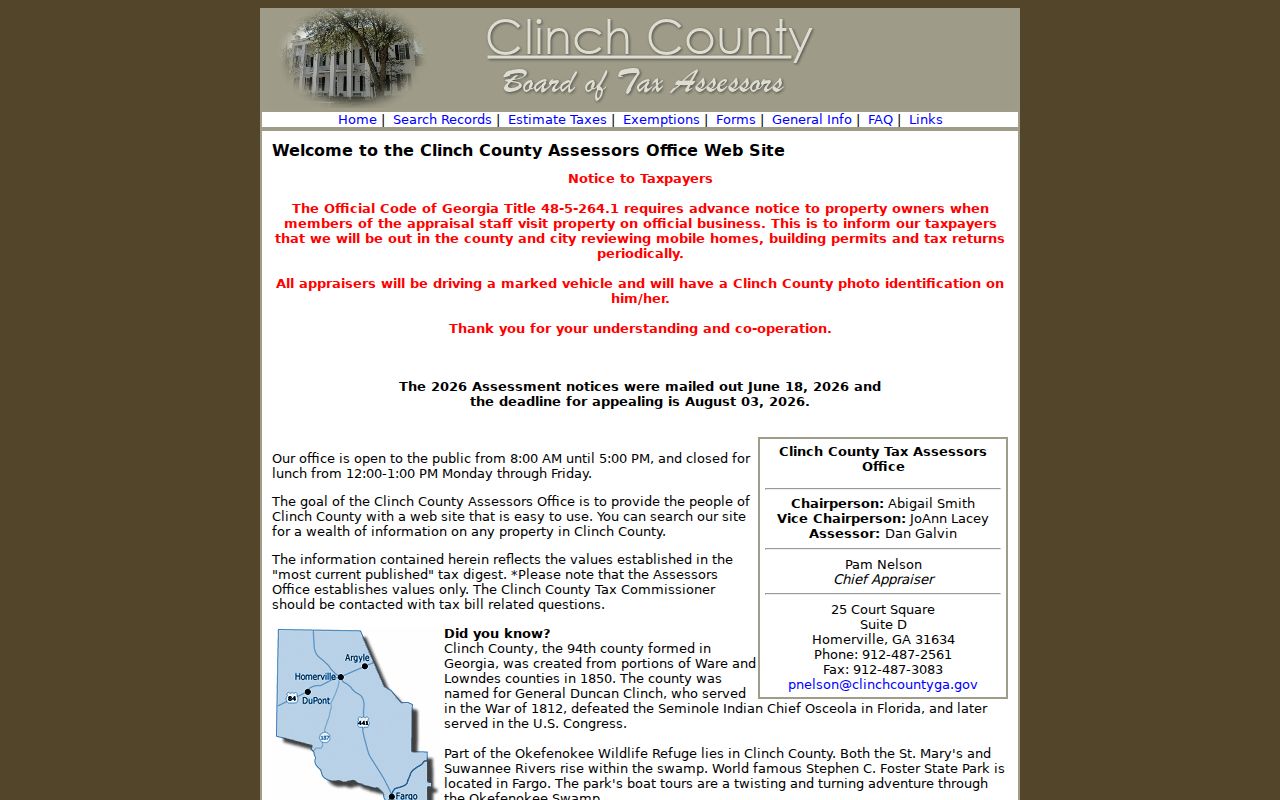
The landing page also lists the local assessor contact and the path into parcel records, which keeps assessment questions and tax-collection questions pointed at the right office.
| Owner field | The assessor-listed name tied to the parcel |
|---|---|
| Mail address | Where assessment or tax mail is directed |
| Situs address | The physical location used for the parcel search |
| Parcel ID | The stable key for comparing records and maps |
| Deed reference | A book and page lead for the recorded instrument |
| Sale field | A dated transaction lead, not proof of current title |
Keep in mind that the assessor's current owner is not always the occupant. A mailing address can sit in another county entirely. The tax-bill recipient may differ from the deed's grantee. So hold those roles apart. A QPublic card is an assessment aid rather than a title opinion. Its parcel ID still makes it the most useful starting record for a present-day check of Clinch County property records.
QPublic's Clinch County Role
The Clinch County Board of Tax Assessors values property. It also maintains assessment maps, receives returns, handles appeals, and supports inspections. It sits at 25 Court Square, Suite D, in Homerville. The Tax Commissioner, in Suite H, bills and collects from the digest. That division matters when you check a current owner. Card and owner-field questions go to the assessor. Payment status goes to the Tax Commissioner.
The Georgia Department of Revenue county directory draws the same line between the two jobs. It also points users to the Clinch property-record link. Note the assessment year and the date of your lookup. An annual record can lag behind a deed filed after the digest or card update. A fresh deed record may not appear yet.
Note: A tax mailing name is a useful lead, but it does not by itself establish the current owner or marketable title.
Latest Clinch County Deed Check
The Clinch County Clerk of Superior Court records the deeds. The office sits at 25 Court Square, Suite C, in Homerville. Filings include deeds, easements, plats, liens, and security instruments. The GSCCCA Real Estate name search spans the state. It is the main index route for a current owner check.
Read the newest deed result closely. Note each party's spelling. Note the grantor or grantee role, the instrument type, the recording date, and the book and page. The live index window runs from January 1, 1990 through August 4, 2026. The explanatory page says statewide data exists from at least 1999 and keeps growing. Neither claim promises every older book is online.
Verify Clinch County Ownership Now
Date every source you use. Follow the parcel, not just a familiar name. Treat the current owner field as a lead, and let the most recent recorded conveyance confirm who owns the Clinch County parcel.
- Search QPublic by address, owner, parcel number, and legal information. Save the parcel ID, exact owner field, assessment year, and lookup date.
- Search that name in GSCCCA for Clinch County. Narrow by grantee role, instrument type, and date when needed.
- Open the latest likely conveyance or send its book/page citation to the clerk if the image requires an account or is unavailable.
- Compare the legal description and parcel clues. Report any different tax-mail, assessor, and deed names as separate fields.
- Owner of record
- The party named by the record being cited, with the record date stated.
- Vesting
- The way the recorded instrument places title in a person, trust, or entity.
- Registered agent
- The public contact for a Georgia entity, not proof that the agent owns its land.
When Clinch County Names Differ
Three records can show three names. QPublic may list one assessor owner, the latest deed another recorded grantee, and the tax bill a third mailing recipient. Do not pick the name that simply looks newest. Record all three, date each source, and ask the office that keeps the field.
Present-owner rule. A difference may reflect a coverage gap or normal administrative lag. Only the recorded instrument and its legal description can explain the conveyance.
A deed search can look incomplete. When it does, pull the known citation through the GSCCCA book/page form or request the instrument from the clerk. State what each source lists. Do not call the assessor wrong just because a web index returned a different name for the parcel.
Entity Owners in Clinch County
Some Clinch County parcels belong to companies, not people. The tax roll will show the entity as owner of record. Copy that name exactly. Then run it through the Georgia Secretary of State business search to pull its control number, status, registered agent, and officers when listed. Punctuation and abbreviations trip up lookups. So try Starts With, Contains, and Exact Match versions of the name.
One caution matters here. An officer or registered agent is not the parcel owner. The entity holds the deed, but that does not make its people owners. Weigh the entity's formation or termination dates against the deed date. Keep grantee, agent, and applicant roles separate as you read. Trusts and estates require the deed language itself. Public index summaries rarely spell out every beneficial interest behind a Clinch County property record.
Clinch County Recording Alerts
A legitimate transaction has to close first. After that, the free GSCCCA FANS service can watch a specific name, address, or document and book/page reference on your behalf. An alert might point to a later deed, lien, plat, UCC, or PT-61 filing. Treat each notice as a lead. It is not prevention, and it is not a title guarantee.
Spell the monitored name exactly. Keep alert messages private. Before changing any current-owner conclusion, confirm the match in the official index or with the clerk. Alerts prove most useful after the assessor and deed records already agree. A later recording may explain why the present owner field changes.
Clinch County Owner Evidence Package
A defensible current-owner file holds several pieces. Keep the QPublic card, the assessment source date, the newest deed citation or image, and the legal description. Keep the newest deed citation or image separately. Add a mismatch note where names disagree. Commercial parcels also benefit from the Secretary of State entity record. An estate-owned parcel needs the probate authority and any later estate or heir deed. These additions do not replace the conveyance. They explain the names found around it.
A negative search deserves precision too. State the system, the input, the date, and the coverage searched. Then name the next custodian. "No owner found" is too broad when QPublic was challenged. A GSCCAA image was gated. The query used only one spelling. The same care applies to parcel splits and combined tracts. Match the land description before treating a current owner name as tied to the subject property. The land description must match the subject property.
Freshness matters as well. Recheck the card and deed at the point of use. Ownership, office staff, portal fields, and index-through dates can all change. This modest evidence package makes a present-tense conclusion auditable. It does so without drifting into the backward history that belongs to a former-owner search.
Current Clinch Owner Role Labels
Publication language should match the source. Say "assessor-listed owner" for QPublic. Say "recorded grantee" for a deed. Say "tax-bill recipient" for billing. A municipal permit holder, contractor, company officer, registered agent, or historical reference plays a different role entirely. Keeping those labels straight prevents a public record from claiming more than it shows.
A current-owner conclusion also needs a date. The assessor card may reflect an annual cycle, while a recording carries its own filing date and an index-through date. If an account gate blocks an image, cite the index entry and request the deed itself. Never treat an unavailable image as proof that no deed exists.
Contacting a Clinch County Owner
The public mailing field can support a written property inquiry, such as a boundary question or a purchase offer. It does not prove where anyone lives. Georgia's Safe at Home program provides address confidentiality and mail forwarding for eligible people, so protected data must not be reconstructed or sought through other records.
Use the least personal detail needed. A current owner lookup supports lawful property diligence, estate research, and civic transparency. It does not authorize watching, targeting, or pressuring a person.
Lawful use. Public owner information may be used for legitimate property matters. Never use it to stalk, harass, intimidate, or harm anyone.