
Identify a Clinch County Property Owner
The route to an owner runs through the Clinch QPublic landing page for the parcel lead, then the statewide recorded index for proof of the latest conveyance. Start broad. Find the right parcel first. Then narrow the search with identifiers that still work when an address is incomplete.
- Locate the parcel by address, street prefix, owner, parcel number, and legal information.
- Save the exact owner field, parcel ID, situs and mailing addresses, assessment year, and lookup date.
- Search the recorded index for the newest conveyance tied to that name and land.
- Compare legal descriptions, dates, and book/page citations before naming the owner.
Clinch QPublic Starts the Route
The Board of Tax Assessors keeps parcel and assessment facts. Its office sits at 25 Court Square, Suite D, in Homerville. A QPublic card lists the parcel ID and owner. It also shows mailing and situs addresses, legal description, land size, values, exemption, tax district, sale data, and deed citation. The live portal can throw up an access challenge. Verify the exact labels on screen.
The Georgia DOR directory confirms the county link and separates assessment from tax collection. Card questions go to the assessor, not the collector. A blocked page is an access event, not proof that no owner record exists.
The image shows the official Clinch QPublic landing page.
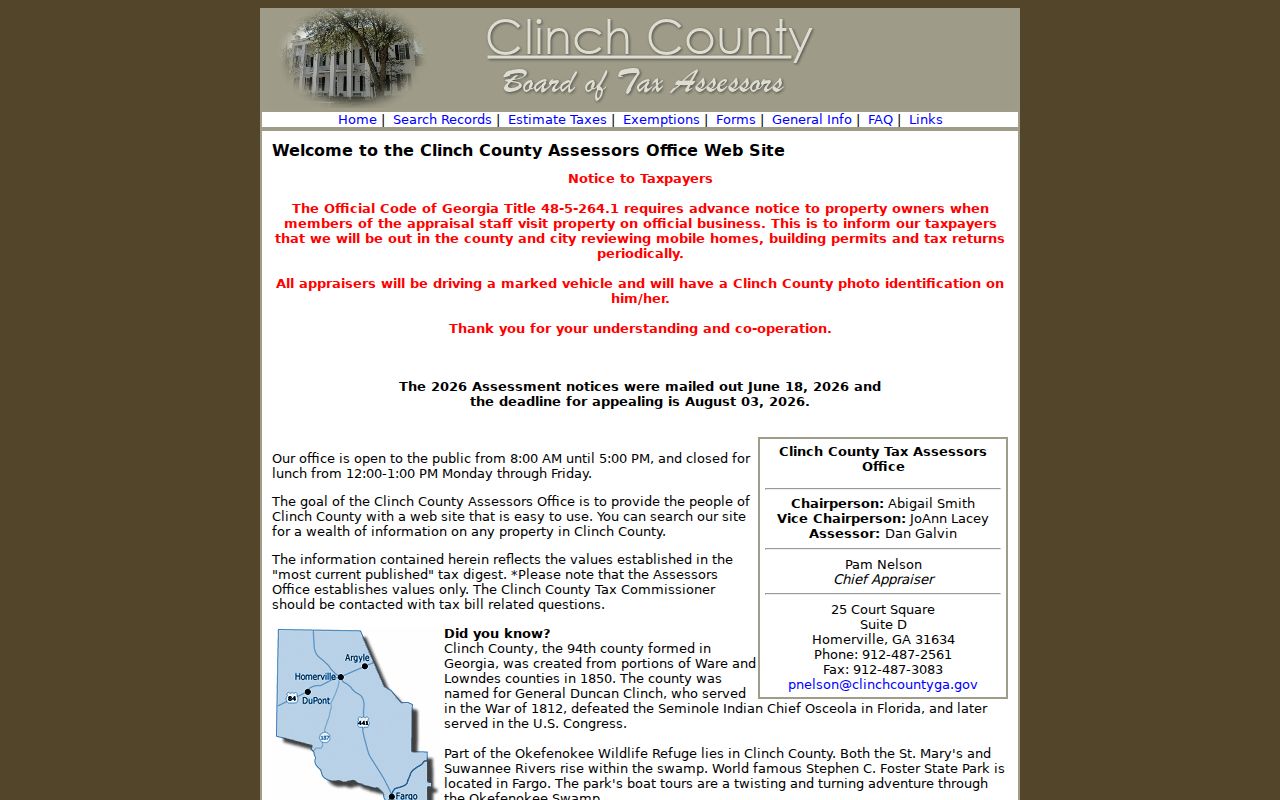
Its listed details point card questions to the assessor.
Clinch Deeds Confirm the Owner
The Clinch County Clerk of Superior Court keeps deed records. The office sits at 25 Court Square, Suite C, in Homerville. The statewide GSCCCA index is the search tool. It filters by exact name, grantor or grantee role, instrument, county, and date. Save the spelling, document type, recording date, book and page, and image status. Images can require an account. Send the citation to the clerk instead. Use the name or book/page routes. The property and subdivision search omits Clinch.
Sources Behind Clinch County Ownership
Each record answers one narrow question. The assessor links a roll name to a parcel, the recorder documents a transfer, and the Tax Commissioner handles the tax bill. Court or probate files may explain an order or estate.
| Source | Owner Info It Gives | Access |
|---|---|---|
| QPublic | Assessor owner, address, parcel ID | Public portal |
| GSCCCA / clerk | Recorded grantee and citation | Index; images vary |
| Tax Commissioner | Bill recipient and tax account | Office / payment portal |
| Probate or court | Authority, orders, case context | Office / provider |
Say QPublic lists A, the deed lists B, and the bill goes to C. Report all three with dates. Ask each office only about its own field, and never pick the newest-looking name without a document behind it.
Entity Owners in Clinch County
Copy a company name exactly. The Georgia business search can return a control number, status, registered agent, or officers. Punctuation varies, so test exact and partial matches. The agent is not the owner. The entity holds the land, so compare the entity and deed dates and keep owner, agent, permit applicant, and occupant roles apart. Trusts and estates likewise require the vesting text and any related deeds.
Clinch County Sale-Update Gaps
A filed deed and the annual assessment card update on different schedules. So date both searches. Names can disagree in between. Inspect the newest instrument and legal description, then ask the assessor when its card changed.
A sale price does not settle ownership. It can be old, non-arm's-length, or tied to several parcels. Fair-market and assessed values are valuation fields rather than proof of the owner of record.
Note: Treat a mismatch as a dated difference between sources. It is not proof that one office is wrong.
Clinch County Filing Alerts
The GSCCCA FANS service is free. It can monitor an exact name, address, or book/page reference, and its alerts may point to a later deed, lien, plat, PT-61, or UCC filing. It is not prevention or a title guarantee. Keep alerts private. Verify each match in the official index, since FANS works best after the owner method has established exact names and citations.
When a Clinch Owner Route Branches
Some parcels force a second path. An estate calls for Probate Court authority, orders, and any recorded estate or heir deed. A business needs more care. Match the entity name and control number. A boundary tract needs the parcel ID, the latest legal description, the recorded plat, and the easement records. Every branch loops back to one question: does the newest relevant deed describe this land and name this grantee?
A delinquency or foreclosure notice is only a lead. Check the Tax Commissioner for the tax stage. Check the court for a case or order. Search GSCCCA for a foreclosure, sheriff's, or tax-sale deed. A notice, execution, or assessor change alone does not prove title passed, and later redemption, release, or conveyance records can change the result.
The minimum useful package is the QPublic card and map view, the assessor's source date, the latest deed citation or image, the legal description, and a note on any lag or mismatch. Recheck it before use. Cards, recordings, portal coverage, and office details all change.
Clinch County Address Problems
Postal geography, civic geography, and parcel geography rarely match up in Clinch County. USPS will normalize a street, city, and ZIP for you. Census tools go another way. They can return a place, a tract, a district, or the county itself. Neither source can name the owner of record. Neither can prove that a person actually lives at the address.
Carry the normalized address into QPublic instead. Let the parcel number and legal description do the real work. Rural Clinch County parcels often yield to the road prefix. The owner name, the acreage, or the land description can work too. When several results come back, keep every candidate parcel ID rather than grabbing the first one. A sound property search explains why one parcel was chosen. It also explains why the rest were set aside.
Limits of a Clinch Owner Search
An owner name on its own proves very little. It does not establish occupancy or a clean chain of title. It does not settle lien priority, boundary location, or where a person actually lives. USPS and Census geography can normalize a location. But neither one settles ownership or residence. QPublic lines are not a survey.
Before a purchase or a boundary dispute, pull the deeds and plats from the deed records. Get qualified review. Georgia Safe at Home also protects substitute addresses for eligible people. Those records should never be reconstructed.
Lawful use. A Clinch County owner lookup supports property diligence. Never use owner information to stalk, harass, intimidate, or harm anyone.