
Read the Clinch County Property Tax Record by Field
Reading a Clinch County property tax record starts with knowing which office holds the field you need. Two offices split the work. The Board of Tax Assessors values property. It also maintains the assessment card for each parcel. The Tax Commissioner builds the digest. That office mails the tax bill, collects payments, and processes exemptions. It also pursues delinquency through executions. Match your question to the right office before you dig into any record.
| Tax-record field | What it means | Clinch custodian |
|---|---|---|
| Fair-market value | The assessor's estimate of market value for the stated year | Board of Tax Assessors |
| Assessed value | Generally 40 percent of fair-market value under Georgia guidance | Board of Tax Assessors |
| Exemption | An approved deduction or tax treatment | Assessor and Tax Commissioner |
| Millage | The levy applied in the tax calculation | Tax-billing records |
| Bill and payment | Tax charged and status for a tax year | Tax Commissioner |
| Execution or sale lead | A delinquency-stage record requiring follow-up | Tax Commissioner and clerk |
Treat every figure as belonging to a dated record with one purpose. A fair-market value is an assessment, never a sale price. A tax bill proves what was owed, not who holds the deed.
Two Clinch County Offices Divide Tax Work
The Board of Tax Assessors sits at 25 Court Square, Suite D, Homerville, Georgia 31634, telephone 912-487-2561. Its duties cover annual valuation, corrected returns, equalized assessments, appeals, tax maps, mobile homes, and support for building-permit inspections. The Tax Commissioner works from Suite H in the same courthouse complex, telephone 912-487-2480. Contact that office for the digest, billing, collections, and exemptions.
Assessment questions
Ask Suite D for the parcel card, map, sketch, value notice, return, exemption file, appeal file, and any available historical card.
Billing questions
Ask Suite H for the bill, payment or delinquency status, execution, exemption receipt, mobile-home tax material, or tax-sale follow-up.
Staff titles differ between the county site and older QPublic text. Verify the current contact before any appeal-related filing.
Find Clinch County Assessment Values in QPublic
Clinch County keeps its parcel and appraisal data on QPublic. The official Clinch QPublic page names the appraisal office. It sends tax bill questions to the Tax Commissioner. From there, a property search runs by address, owner, or parcel number. You can also search by legal description when that field holds data. Field labels can change, so check them as you go. The Clinch QPublic landing page itself is the place to start.
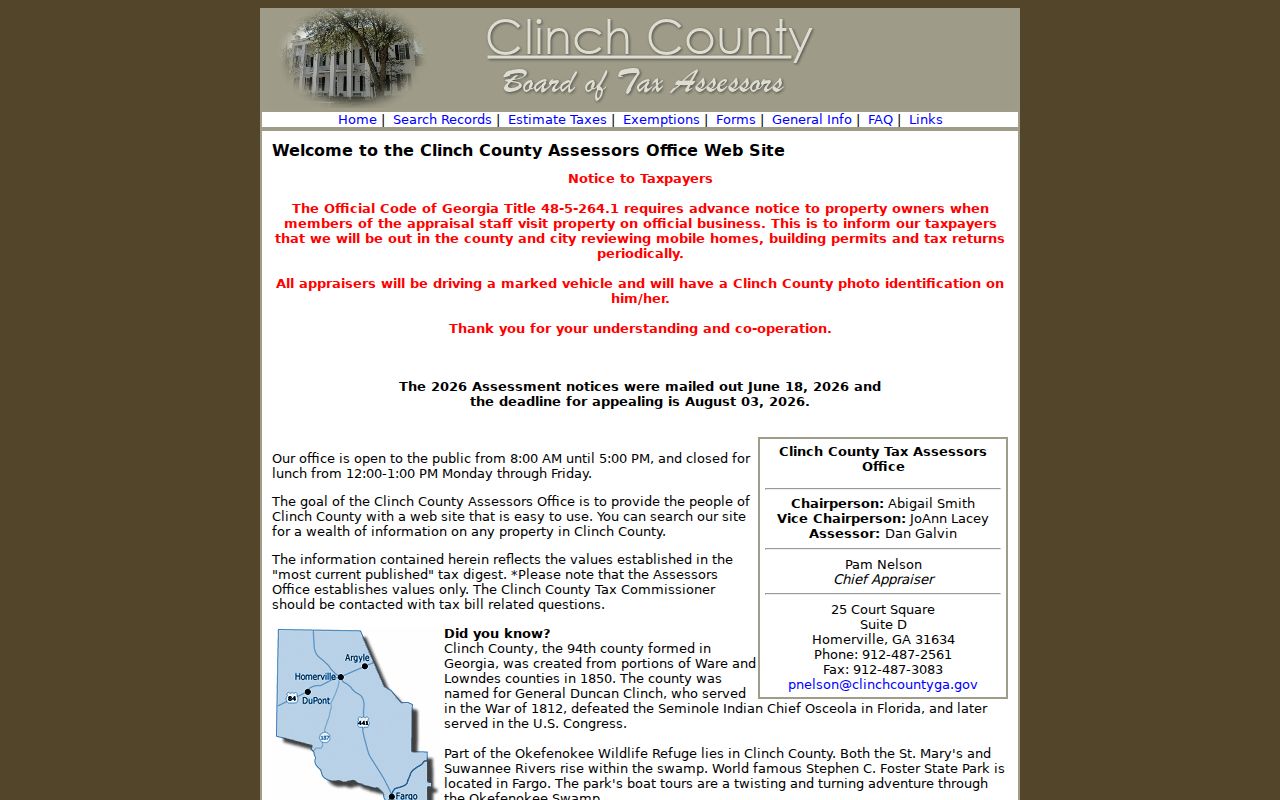
Open the live page for current notices.
- Search the situs address and try street-prefix variants if no direct result appears.
- Open the likely card and match parcel ID, owner, acreage, and legal description.
- Write down assessment year, land value, improvement value, total fair-market value, assessed value, and exemptions as labeled.
- Preserve the notice or card date before comparing another year.
- Carry the parcel ID to the Tax Commissioner for bill and status questions.
A property search result can trail a newer deed. Check the card date against the recorded conveyance before you call anyone the owner of record.
Calculate Clinch County Property Tax Without Merging Values
Georgia Department of Revenue guidance puts most assessments at 40 percent of fair-market value. Clinch County follows that rule. The tax bill then comes from a short formula. Take the assessed value, subtract any exemptions, and multiply by the millage rate. That is why one parcel shows several numbers that never seem to match.
- Fair-market value
- The assessor's value concept based on an arm's-length exchange.
- Assessed value
- The statutory assessment portion used before exemptions and millage.
- Taxable value
- The base remaining after applicable exemptions or adjustments.
- Millage rate
- The levy applied to the taxable base to compute tax.
Treat the formula as a reading aid. It cannot replace the actual Clinch County tax bill, so pull special districts, approved exemptions, and the tax year straight from the property records.
Use the Clinch County Tax Payment Entry Carefully
Clinch County posts a GovernmentWindow entry page for property taxes. The lookup and payment flow sits behind robot verification. Because of that, owner, parcel, balance, fee, and receipt fields cannot be previewed here. That challenge page is not proof that online access is missing. It simply guards the payment path.
Use a normal browser to complete the transaction. Match the parcel number and tax year carefully. Save the bill or receipt label exactly as it appears. For authoritative answers on payment, delinquency, execution, or tax-sale status, contact the Clinch County Tax Commissioner. Ask whether the record is current. Also ask whether any later satisfaction, transfer, redemption, or deed activity exists.
Separate Clinch County Delinquency from a Tax-Sale Deed
Delinquency in Clinch County unfolds in stages. A past-due balance comes first. Then the Tax Commissioner issues executions against delinquent taxpayers. The Superior Court clerk records fi fas and real-estate instruments. A sale notice, auction, tax-sale deed, redemption, and later conveyance each follow as separate steps. Check both custodians before drawing any conclusion about a parcel.
| Stage | Record to obtain | What not to assume |
|---|---|---|
| Unpaid bill | Dated tax status | That a sale occurred |
| Execution | Fi fa or execution details | That title changed |
| Sale notice | Official notice and legal description | That the sale completed |
| Tax-sale deed | Recorded deed citation and image | That title is clear |
| Later event | Redemption, release, or conveyance | That the first result is current |
Note: A Clinch County tax deed can carry redemption and title issues, so obtain professional title advice before any transaction or dispute.
Review Clinch County Homestead Exemptions
Georgia sets the general rules for homestead exemptions. An applicant usually must own and occupy the home as a legal residence. That status applies on January 1. Filing is due by April 1 or within the assessment-appeal window. The standard state exemption is a $2,000 deduction from the 40-percent assessed value. Senior, educational, floating, disabled-veteran, and surviving-spouse categories also exist.
Those are state-level categories only. They do not show that any person qualifies. Confirm the current Clinch County form, evidence, and filing route with the assessor. Check local additions with the Tax Commissioner. Keep the filed application and office response with the tax-year record.
Protect the Clinch County Assessment Appeal Window
Georgia's Department of Revenue lets a Clinch County owner appeal on several grounds. You can challenge taxability, uniformity, the assessed value, or a denied exemption. The appeal goes through the Board of Tax Assessors. The filing window lasts 45 days from the assessment notice.
The county's QPublic portal showed the 2026 cycle in detail. Notices went out on June 18, with appeals due by August 3. Those dates belong to that year alone, so confirm current deadlines before relying on them.
Use the notice in hand. Preserve its mailing date, parcel ID, value fields, and deadline, then confirm the current filing method with the Clinch County Board of Tax Assessors.
Bring real proof to the hearing. Strong evidence might be comparable property cards, photographs, repair documentation, a survey, deed terms, or a formal appraisal where one applies.
For the bigger picture, the Clinch County property value guide breaks down why assessed, market, and sale figures can diverge on the same parcel.
Request Missing Clinch County Property Tax Records
An online field may be blocked. An older year may be missing. Request the record from the office that holds it. Include the parcel ID, and add the situs and the legal description. Name the tax years, the record type, and your preferred electronic format. Ask for a cost estimate before any extensive search or certification work.
Georgia's Open Records Act generally requires production or a response within three business days. The Attorney General notes that copying may cost up to 25 cents per page. Reasonable search and administrative costs can apply. The first 15 minutes of staff time are free. An agency does not have to create a new report. Request the card, bill, execution, exemption file, or notice rather than an analysis.