
Clinch County Former-Owner Sources
The newest recorded deed is your starting point. Every grantee took an interest, and every grantor gave one up. Reading those roles backward, link by link, rebuilds the ownership history without mistaking a tax name for the owner of record.
| Source | Years It Covers | Where Held | What It Shows |
|---|---|---|---|
| GSCCCA name index | Displayed 1990 to 2026 | Online statewide index | Parties, roles, instruments, dates, book/page |
| Clerk deed books | Older and unindexed series | Superior Court clerk | Recorded instruments and legal descriptions |
| Court and estate films | 1867 to 1931 and related runs | FamilySearch / Archives | Fiduciaries, heirs, orders, estate land |
| Historic tax digests | Varies by collection | FamilySearch / Archives | Annual owner leads, not conveyances |
Begin the chain online. Copy each book and page citation, then compare the legal description at every step so the tract stays the same. When a citation falls before usable web coverage, order that book from the Clinch County Clerk of Superior Court at 25 Court Square, Suite C, Homerville. Archival catalogs may hold the same series.
Reconstruct Clinch County Ownership
The GSCCCA name search lets you filter by party role, instrument type, county, and dates, with a neighboring-county option for border tracts. Take one recorded link at a time. Never assume the first matching surname is your former owner.
- Find the present grantee's newest likely purchase deed and record its legal description and citation.
- Read the grantor, then search that person as a grantee to find the earlier acquisition.
- Repeat while tracking married names, entities, estates, acreage changes, splits, and referenced prior deeds.
- When the online chain ends, continue through clerk deed books, microfilm, probate files, and tax-digest leads.
- Grantor / grantee
- The party conveying an interest and the party receiving it.
- Chain of title
- The ordered sequence of recorded transfers for the same land.
- Legal description
- The land description that links old deeds when street addresses fail.
GSCCCA's Clinch County Cutoff
GSCCCA's own explanatory material says statewide records run from at least January 1, 1999, and historical data keeps being added. Coverage still varies by county. Not every Clinch deed book is online. So preserve exact spelling, party role, instrument type, recording date, book and page, and image status for each entry. Some images need a paid account tier. With a citation in hand, the book/page form beats another broad name search. The clerk can pull the book too. The GSCCCA name-search page is the statewide interface where the backward chain begins.
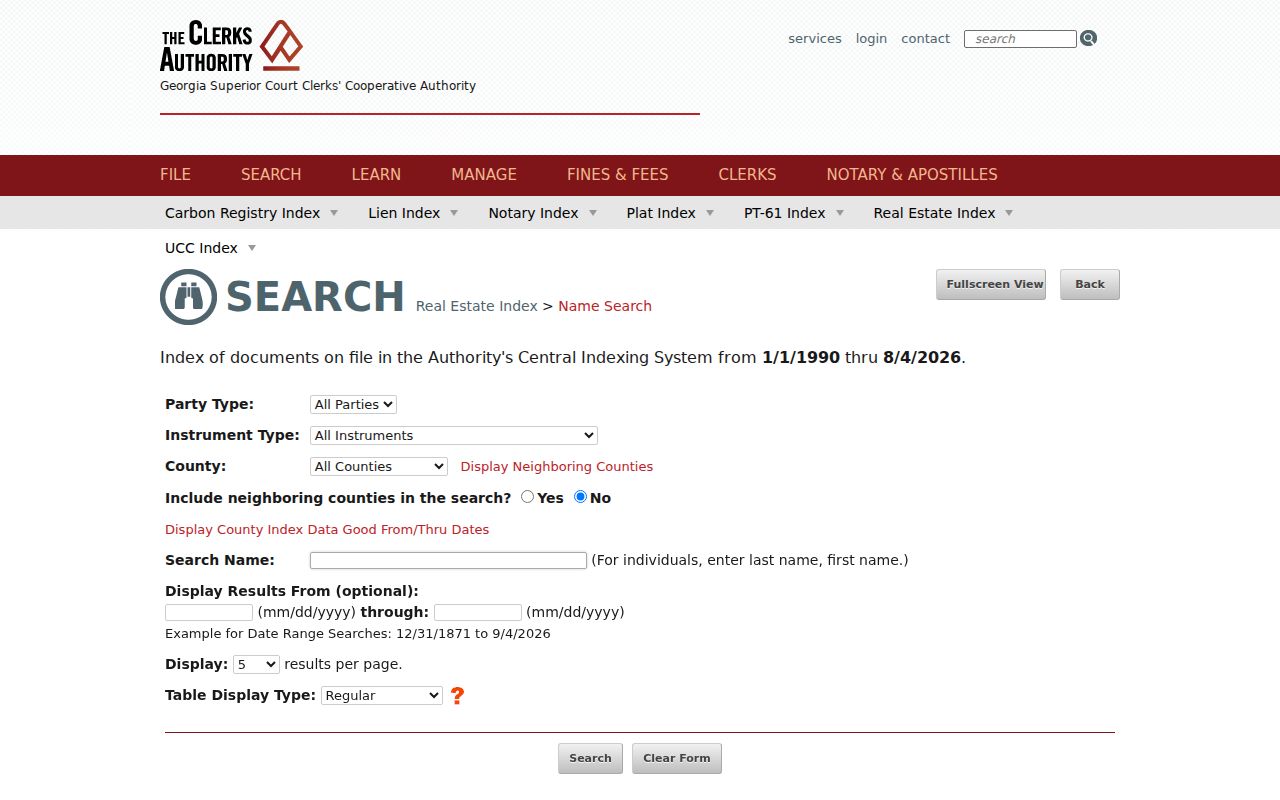
Recheck its live coverage date, filters, and image access before relying on the capture.
Online limit. A missing web result can mean an unindexed book, restricted image, spelling change, or coverage gap, not the absence of a former owner.
Clinch County Estate Transfers
A death can snap a deed chain in two. A will or an inventory may describe land without moving title. That transfer usually sits in a separate document. Hunt for the order admitting the will, the fiduciary authority, any order of sale or distribution, and the later heir deed.
The Clinch FamilySearch catalog lists Court of Ordinary minutes from 1867 to 1931, Inferior Court records from 1868 to 1901, and estate material from 1919 to 1921. Five microfilm reels cover the set. Access may require an account or an affiliate site. Once an heir or fiduciary name surfaces, run that exact name through the recorded index.
Earlier Clinch County Deed Geography
Clinch County dates to 1850. It was carved from Ware and Lowndes counties. A chain reaching that far may continue under a predecessor county's deed records. Run the neighboring-county index both ways. Then confirm the legal description tracks the same tract. Older deeds lean on acreage, adjoining owners, creeks, roads, rail lines, and metes-and-bounds calls. Match those clues against later plats and current parcel polygons, but write down every inference rather than forcing one old tract onto a single modern parcel.
Archives for Clinch County Owners
The Georgia Archives opens the door to county deeds, estates, tax material, court minutes, and microfilm. Old books often moved, not vanished. Ask the clerk about the exact series first. A volume may sit at the Archives or exist only on film.
Historic tax digests add yearly name and land leads. The Huxford-Spear library adds family and place context. Neither substitutes for a certified county record, so cite the custodian, volume, page or image, film or DGS number, and date for every item you use.
Old Names Reveal Prior Owners
Today's map name is not always the old one. Argyle was Saussy once. Du Pont carries Suwannoochee and Lawton in its past. Railroad station names and Suwannee River terms can surface plats, rights-of-way, or older deed language that the modern spelling hides. Homerville-area research may turn on Pea Ridge or Five Mile Still survey identifiers.
Treat those as historic-resource references, not parcel numbers. Tie one to a current tract only through a deed call, plat, survey, or legal description. That keeps house-history color apart from proof of ownership. Note: A no-result under today's spelling means little until aliases and predecessor sources are tested.
Documenting Each Clinch Owner Link
Log every transfer fully. Record the date, grantor, grantee, and deed type. Add the citation, the legal-description clue, and whether the image is online. Follow a referenced prior book and page even when the name index points elsewhere. Flag reservations, timber interests, easements, and acreage shifts. They can mean only part of the tract moved.
A negative finding needs proof too. Name the system, the terms, and the coverage. Then state the next stop, whether clerk, Archives, FamilySearch, Huxford, or a predecessor county. Gaps happen. That discipline keeps a gap from hardening into a false claim about former owners.
Depth of Clinch County Ownership
Clinch County former-owner research runs deeper than any single website. The clerk's realty series is the strongest deed fallback when property records online run thin. Probate minutes and court minutes can bridge estate transfers. They carry the chain from one owner of record to the next. Tax digests give dated leads. The Archives helps pin down which permanent property records series survives. It also shows where that series is held.
Know when to stop. Note the last confirmed deed and the gap beyond it. A historical property search only holds up under one condition. Every name must trace back to the same parcel of land.
Lawful use. Prior-owner research supports house history, estate work, and property diligence. Never use it to track, harass, or harm a living person.