
Deed Types Found in Clinch County Records
The Clerk of Superior Court keeps Clinch County deed records. The Georgia Superior Court Clerks Cooperative Authority indexes them. The instrument type carries real weight. A warranty deed, quitclaim deed, security deed, and tax-sale deed each report a different event. Each one marks a different moment in a parcel's history. Start with the label the index gives you. Then read the deed itself before drawing conclusions from the summary line.
| Deed type | What it records | Where to verify |
|---|---|---|
| Warranty deed | A conveyance with stated warranties | GSCCCA and county clerk |
| Quitclaim deed | The grantor's stated interest without warranties | GSCCCA and county clerk |
| Deed from estate | A transfer tied to fiduciary authority | Index, deed, and probate file |
| Foreclosure or sheriff's deed | A conveyance after a legal sale process | Index, deed, and court file |
| Tax-sale deed | The interest conveyed after a tax sale | Clerk and Tax Commissioner |
| Security deed | A real-property security instrument | Index and later releases |
Every deed is one link in a chain. Its reservations, legal description, signing capacity, and references to earlier books can matter as much as the party names.
Search Clinch County Deeds in GSCCCA
The GSCCCA Real Estate Index offers several ways in. A researcher can pick grantor, grantee, or all parties, choose an instrument type and county, set dates, and even include neighboring counties. Begin with the exact owner name. Then test initials, punctuation, former surnames, estate terms, and entity suffixes. Widen the net before narrowing by deed type. The official GSCCCA form displays the statewide deed-index interface where each of these search options appears.
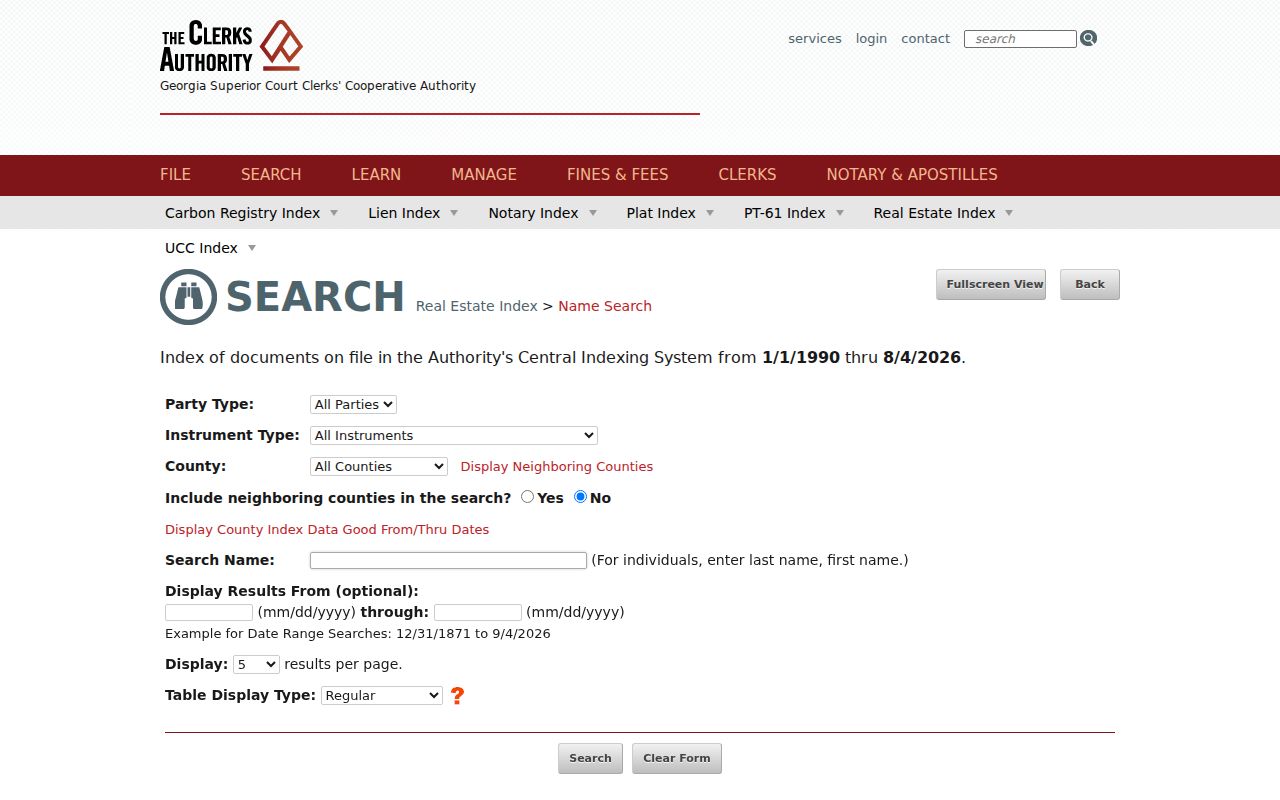
Recheck the current index dates before searching.
| Search field | Practical use | Detail to save |
|---|---|---|
| Party role | Try grantor, grantee, then all parties | Role shown for each name |
| Instrument type | Separate deeds, liens, plats, and releases | Exact category |
| County | Select Clinch; add neighbors if history calls for it | County indexed |
| Date range | Bracket a known ownership period | Search start and end |
| Book/page | Locate a known citation | Exact book and page |
Coverage has limits. The live form spans 1990 through 2026, and GSCCCA's own explanatory material says statewide data exists from at least 1999, with older material still being added. Neither statement promises complete Clinch County images for every volume.
Save Every Field from a Clinch County Deed Hit
A deed search you can reproduce is worth more than a lucky hit. Record the exact spelling, party role, county, instrument type, recording date, book, page, property text, and image status. Copy the index-good-through date as well. Those details let the clerk pull a missing image quickly. They also show any later reader exactly how far the search reached.
| Parties | Exact grantor, grantee, and other indexed roles |
|---|---|
| Recording | Date, county, instrument type, book, and page |
| Property | Legal-description summary or location text |
| Access | Image, print, and certified-copy status |
An index line is only a locator. It cannot reveal every exception or prove that the named tract matches your parcel.
Trace the Clinch County Grantor-Grantee Chain
Work backward by finding the newest likely deed and identifying its grantor. Search that grantor's earlier purchase as a grantee next. A forward search flips the method: follow each new grantee into later grantor entries. Keep the legal description beside every step. One owner can hold more than one tract in the county.
- Use QPublic only to obtain a current name, parcel ID, and legal-description lead.
- Find the newest conveyance and note parties, date, book/page, and land text.
- Search its grantor as an earlier grantee and compare the same tract.
- Repeat, marking each link confirmed, index lead only, or unresolved.
- Check estate, court, foreclosure, and tax-sale records when the chain breaks.
- Grantor
- The party conveying the stated interest.
- Grantee
- The party receiving the stated interest.
- Chain of title
- The linked sequence of recorded interests for the same land.
- Book and page
- The citation used to retrieve a recorded document.
Reach Clinch County Deed Images and Certified Copies
GSCCCA splits index searching from image access. The account page lists a Limited Use option for index summaries. Single Use costs $5 for four hours plus $0.50 per printed page. Premium runs $29.95 monthly with unlimited image viewing and the same $0.50 per printed page. Confirm current prices before paying. When a scan is missing, contact the Clerk of Superior Court at 25 Court Square, Suite C, Homerville, Georgia 31634, telephone 912-487-5854. Certification matters can go there too. Give the staff names, instrument type, recording date, book and page. Add the legal description and parcel reference. Counter, telephone, and written requests fill the gaps the web index leaves open.
Go Beyond Online Clinch County Deed Records
Clinch County was formed in 1850 from Ware and Lowndes Counties. An early chain can therefore lead outside today's county lines and beyond any online index. The Georgia Archives notes that older deeds, tax material, court minutes, and estate records may sit in volumes. Some of that material is on microfilm. It must be browsed in person. Search the predecessor counties whenever the land or owner predates Clinch. Old tracts were often described by land lots, districts, and acreage. Neighboring owners, roads, or water marked boundaries too. A street address rarely appeared. Compare those calls with plats and later deeds before tying an old tract to a modern parcel number.
Link Clinch County Estate Papers to Deeds
An estate can break a simple seller-to-buyer sequence. Search the decedent, the fiduciary, the estate itself, the heirs, and the purchaser. GSCCCA includes estate-documentation and deed-from-estate categories. Probate Court may hold the will, fiduciary letters, inventory, order of sale, or distribution record. The FamilySearch catalog lists Clinch Court of Ordinary minutes from 1867 through 1931. It also lists miscellaneous estate material from 1919 through 1921. A will that mentions land is not necessarily the conveyance. Locate the authority behind the transfer and any later recorded deed.
Follow Security Deeds, Assignments, and Releases
Clinch County deeds often travel with security deeds, assignments, releases, liens, easements, rights-of-way, and fi fas. Search borrower and lender names separately. Try later corporate names too. A release may cite the old book and page, the loan, or the security-deed date rather than the current owner of record.
| Record | Question | Required follow-up |
|---|---|---|
| Security deed | What obligation was secured? | Assignments and release |
| Assignment | Who later held the interest? | Successor names |
| Release | Which earlier filing was satisfied? | Match citation |
| Easement | What use or access was recorded? | Read plat and land text |
| Lien or fi fa | What claim was indexed? | Find satisfaction or court record |
No release under one spelling does not prove the obligation still stands. Record the names, dates, and categories you searched.
Watch New Clinch County Filings with FANS
The free Filing Activity Notification System can monitor a name, address, or book-page reference for later deeds, liens, plats, UCCs, and PT-61 activity. The statewide system launched in 2023 and reported more than 85,000 enrolled users by June 30, 2025. That is statewide activity, not a Clinch-only count.
An alert is a reason to inspect the official filing. It does not stop fraud and does not decide whether an instrument is valid.
Request a Clinch County Deed from the Custodian
Use the index to build a precise citation first. Then request the existing document rather than asking staff to create a title report. State the grantor, grantee, instrument type, recording date, book and page, and parcel reference. Say whether you want electronic or certified copies. Ask about costs ahead of time, since local copy and certification fees are not published here.
Recorded, not guaranteed. A Clinch County deed index shows that an instrument was recorded. It does not decide validity, priority, enforceability, releases, or marketable title.
Need the full chain of title? The former owners guide walks through earlier owners of record in Clinch County step by step. A deed dispute, lien, or purchase question can also call for a Georgia attorney or title professional.